

Thinking of investing in student accommodation? It can be a smart financial decision, offering potentially high returns. Our team of buy to let student property experts guides you through every step of the process, ensuring a smooth and successful investment journey.
What is a student buy-to-let mortgage?
A student buy-to-let mortgage is a type of financing that allows you to purchase a property specifically for renting it out to students. These mortgages are offered by lenders who are willing to lend on student properties, which are often seen as higher risk by some lenders.
Key features of student buy-to-let mortgages include:
- Lending on student houses and purpose-built student accommodation (PBSA).
- Higher rental yields compared to standard buy-to-let properties due to multiple students renting.
- Potential for capital appreciation of the property value over time.
- Higher deposit requirements than standard buy-to-let mortgages.
To qualify, you’ll typically need to meet criteria such as a minimum income, good credit history, and the property meeting certain standards for student occupancy.
Using a mortgage broker can help you find the most suitable lender and deal for your student buy-to-let investment.
Buy-to-Let Mortgage Calculator
Our buy-to-let mortgage calculator takes the guesswork out of financing. Quickly see potential monthly costs and total loan repayment, helping you make informed investment decisions.
Plan Your Student Property Investment
What is the criteria for a student Buy-to-Let mortgage?
To qualify for a student buy-to-let mortgage, property investors typically need to meet the following criteria:
- Minimum deposit of 25% or more.
- Minimum income of at least £25,000.
- Ability to complete the mortgage before age seventy.
- Experience as a landlord – some lenders require prior experience, while others accept first-time landlords.
- Rental income must cover at least 125-180% of the mortgage payments.
- Property must be located in England, Scotland or Wales.
- Loan amount between £2m – £45m.
- Lender may send surveyors to value the property.
- If renting to 5 or more unrelated tenants, a HMO (House of Multiple Occupation) license is required.
- Purpose-built student accommodation (PBSA) properties are often cash-only investments.
Lenders will assess the potential rental income on a room-by-room basis for houses of multiple occupation (HMOs) and shared apartments.
What types of property can you use For Student Accommodation?
Several types of properties can be used for student accommodation:
- Houses of Multiple Occupation (HMOs): These are traditional houses rented out to multiple students, often with shared living spaces and bathrooms.
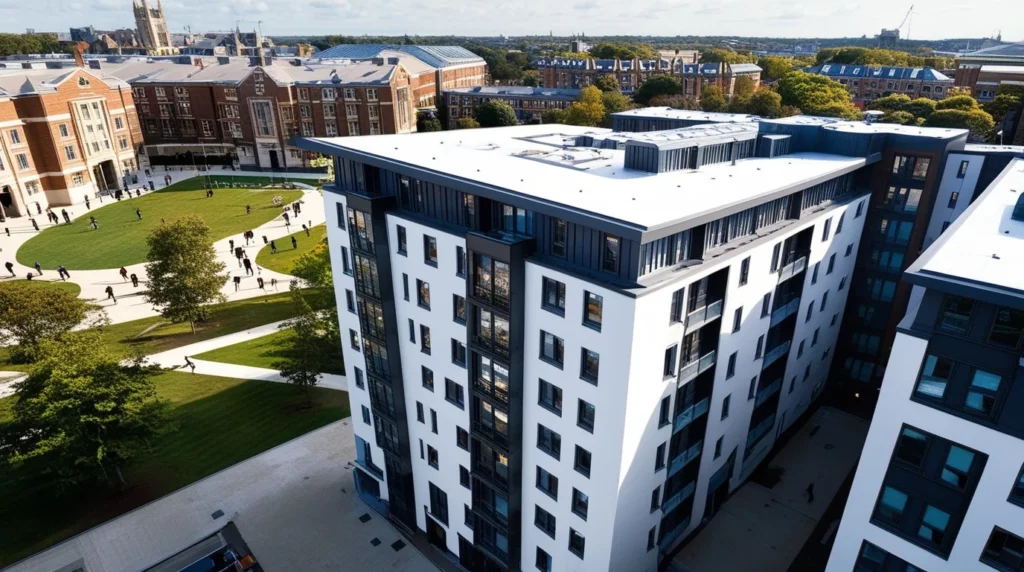
- Purpose-Built Student Accommodation (PBSA): These are specially designed buildings that provide individual rooms or suites, often with shared amenities like kitchens and lounges.
- Flats and Apartments: Many students choose to rent individual flats or apartments, especially in urban areas close to universities.
- Shared Houses: Groups of students often rent a house together, sharing the costs and living spaces.
Each property type has its own advantages, depending on location, rental yield, and student preferences.
How to Invest in student buy to let property?
To invest in student buy-to-let property, follow these key steps:
- Research locations with universities and high student populations. Look for areas with good transport links and amenities.
- Decide on the type of property to invest in – either a house of multiple occupation (HMO) or purpose-built student accommodation (PBSA). HMOs offer higher yields but require more management.
- Find a suitable property that meets student needs, such as having at least 3-5 bedrooms, living space, and amenities like a washing machine.
- Ensure the property meets all legal requirements for student rentals, such as having the necessary licenses and safety features like fire alarms.
- Market the property to students well before the start of the academic year, as most search in November for the following September.
The key is choosing the right location, property type, and managing the legal and financial requirements. With high demand and yields, student buy-to-lets can be a lucrative investment for experienced landlords.